How Much Is The Millenium Cabbage Patch Doll Worth
| Type | Dolls |
|---|---|
| Company | Coleco (1982–1988) Hasbro (1988–1994) Mattel (1994–2003) Toys 'R' Us (2003) Play Along (2004–2011) Jakks Pacific (2011–2014) Wicked Cool Toys (2015–present) |
| Country | United States |
| Availability | 1978–present |
| Official website | |
Cabbage Patch Kids are a line of soft sculptured toy doll like creatures sold by Xavier Roberts and registered in the United States copyright office in 1978.
The doll brand was one of the most popular toy fads of the 1980s and one of the longest-running doll franchises in the United States.[1] The characters appeared in many other Cabbage Patch merchandising products ranging from animated cartoons to record albums to board games.
- 1Production history
- 6Controversies
Production history[edit]
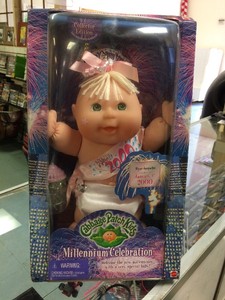
Aug 15, 2017 - We had dolls, soft toys, action men, soldiers, toy cars, and books aplenty. As part of this 'patch kids' mania, you can find this original 80's Cabbage patch. Have the Millenium Falcon Logo set on eBay for almost $25,000. The following are the results we found for you based on Millennium Celebration Edition Cabbage Patch Kids. How much is the millenium cabbage patch doll worth. Jul 8, 2018 - HAPPY NEW MILLENIUM FROM CABBAGE PATCH, LET THE. Used Cabbage Patch Kids doll box in Mansfield. Is the price negotiable?
Creation and development[edit]
According to Roberts, as a 21-year-old art student, he utilized the quilting skills he learned from his mother and the historic technique of 'needle molding' to develop his own line of fabric sculptures. He called these hand-stitched, one-of-a-kind, soft fabric sculptures 'The Little People'. (Other soft sculpture dolls dating back to the 19th century were created using similar needle molding techniques.) His Little People were not offered for sale, but were 'adopted' each with their own individual name and birth certificate. Instead of paying a purchase price, buyers of Little People would have to pay an adoption fee.[2]
The Little People were first sold at arts and crafts shows, then later at Babyland General Hospital, an old medical clinic that Roberts and his friends-turned-employees converted into a toy store, in Cleveland, Georgia.[3]
An early transaction at Babyland General Hospital worth noting is the sale of the only Little People quintuplets ever made at the facility. Bennie and Jeannie Shelton of Cumming, Georgia paid $5,000 to buy the one-of-a-kind set of five identical dolls. Also worth noting is one of Roberts' very first Little People dolls he ever created sold at an auction in Virginia in the early 1980s for $3,000.
The following is an abbreviated version of the origin story Roberts came up with for his Little People:
Xavier Roberts was a ten-year-old boy who discovered the Cabbage Patch Kids by following a BunnyBee behind a waterfall into a magical Cabbage Patch, where he found the Cabbage Patch babies being born. To help them find good homes he built BabyLand General in Cleveland, Georgia where the Cabbage Patch Kids could live and play until they were adopted.
BunnyBees are bee-like creatures with rabbit ears they use as wings. They pollinate cabbages with their magic crystals to make Cabbage Patch babies.
Colonel Casey is a large stork who oversees Babyland General Hospital. He's the narrator of the Cabbage Patch Kids' story.
Otis Lee is the leader of the gang of Cabbage Patch Kids that befriended Xavier.
(This discovery legend would be reproduced on every Cabbage Patch Kids product from 1983 onward.)
Coleco years[edit]
Original Cabbage Patch Doll
The name change to Cabbage Patch Kids was made in 1982 when Xavier's company, Original Appalachian Artworks, began to license a smaller version of the handmade creations to a toy manufacturer named Coleco which began mass production the same year.[4] The Coleco Cabbage Patch Kids had large, round vinyl heads (originally of a different, hard plastic), and soft fabric bodies, and were produced from 1982 to 1989, many at a factory in Amsterdam, New York. The first two years production was all from the Far East, with nine head variations produced and computer-matched with bodies to ensure each doll was 'different'. It was, in fact, a marketing ploy that worked quite well as a wide range of variations resulted. (Source: Larry Moniz, then senior account supervisor for the Coleco account at Richard Weiner Public Relations in NYC.)
At the peak of their popularity, the dolls were a must-have toy for Christmas.[5][6] Parents across the United States flocked to stores to try to obtain one of the Cabbage Patch Kids for their children, with fights occasionally erupting between parents over the hard-to-find dolls. In later years, Coleco introduced variants on the original Cabbage Patch Kids, and derivatives of the original line of dolls continued to be marketed.
International variations[edit]
In the 1980s when Coleco was producing the dolls for the North American market, the global craze was fulfilled by other companies:
- Jesmar Toy Company made the dolls for the European Market, including Spain, Italy, and West Germany.
- Lili Ledy Toy Company made the dolls for Mexico and South America.
- Triang-Pedigree Toy Company made the dolls for South Africa.
- Tsukuda Toy Company manufactured the dolls for Japan and Asia.[7]
The Dolls manufactured by each of these companies, and along with the factories that produced the dolls for North America, produced dolls that were slightly different from one another. Dolls that were made for consumers in other countries than the United States hold a higher value in the eye of some American collectors.
Hasbro years[edit]
Hasbro took over the rights to produce Cabbage Patch dolls in 1988 after Coleco filed for Chapter 11 bankruptcy,[8] and continued to make the dolls with various gimmicks, including dolls that played kazoos. Some of the more popular doll lines to come out under the Cabbage Patch Kids name included the 'Birthday Kids', 'Splash 'n' Tan Kids', and 'Pretty Crimp and Curl'. Hasbro gradually began making the dolls for younger children, which led to smaller and smaller dolls. Although Cabbage Patch dolls were still best selling toys, Hasbro never really revitalized the Cabbage Patch market. In 1994, Mattel acquired the licensing rights to the dolls from Original Appalachian Artworks.[citation needed]
Are Cabbage Patch Dolls Worth Money
Mattel years[edit]

In 1994, Mattel took over the Cabbage Patch brand, including production. The first Mattel Cabbage Patch dolls hit the stores in 1995.[citation needed]
The Mattel Cabbage Patch dolls are not limited to cloth bodies and included dolls made from vinyl, which produced a more durable play doll. The Mattel dolls are mostly sized 14' or smaller, and most variants were individualized with a gimmick to enhance their collectibility, e.g. some dolls played on water-toys, swam, ate food, or brushed their teeth.[citation needed]
Some memorable Mattel lines include the updated Kids line of basic cloth dolls that came with birth certificates, the OlympiKids that were made to coincide with the 1996 Olympics, and the Cabbage Patch Fairies. Additionally, to celebrate the dolls' 15th anniversary, Mattel created a line of exclusively female dolls with a new molded fabric face, dressed in a custom outfits and packaged in collectible boxes. These were 16 inches tall, the same measurement of the first Coleco Cabbage Patch Kids.[citation needed]
Toys 'R' Us Kids[edit]
In 2001, retailer Toys 'R' Us took over the Cabbage Patch brand from Mattel, producing 20-inch Kids and 18-inch babies, both with cloth bodies and vinyl heads. They were packaged in cardboard cabbage leaf seats. In 2001, the 20-inch dolls debuted in the Times Square flagship store. These were created to celebrate the 20th anniversary of the line, and were available both online and in stores around the US.[citation needed]
Play Along Toys[edit]
The Toys 'R' Us line lasted until Play Along toys obtained exclusive licensing rights to produce the Cabbage Patch Kids doll line. In 2003, Play Along launched a Cabbage Patch Kids 25th Anniversary collection using some of the original head sculpts from the very first Coleco editions. Play Along also partnered with Carvel Ice Cream in a co-branding campaign. The resulting co-branded Cabbage Patch Kids were packaged with a Carvel-branded ice cream cone.[citation needed]
Jakks Pacific[edit]
JAKKS Pacific acquired Play Along Toys and assumed the master toy licensee (c2011) for the Cabbage Patch Kids. Jakks introduced a 14-inch Cabbage Patch Kids Fashionality(TM) line and other Cabbage Patch Kid products. In 2013 Jakks Pacific released the Celebration edition to commemorate the 30th Birthday of the licensed Cabbage Patch Kids.[citation needed]
Wicked Cool Toys[edit]
Wicked Cool Toys is now the current master toy licensee for the Cabbage Patch Kids.[9]
In this line, WCT released new additions like Little Sprouts, a toyline of tiny collectable dolls, and Adoptimals, plush pets who interact with the Kids.
Cabbage Patch Kids brand[edit]
The original 1982 Cabbage Patch Kids license agreement with Coleco Industries was negotiated by Roger L. Schlaifer on behalf of Schlaifer Nance & Company, the exclusive worldwide licensing agent for Roberts' company at the time.[citation needed]
Following Schlaifer Nance & Company's signing of Coleco Industries, SN&C signed over one hundred and fifty licenses for branded products ranging from the first children's licensed character diapers and low-sugar cereal to clothing, backyard pools, and thousands of other children's products — generating over $2 billion in retail sales for 1984, alone. Total sales during the Schlaifers' tenure exceeded $4.5 billion. While sales of the dolls and other licensed products declined precipitously in the late 1980s, the dolls have become a mainstay of the toy industry, and one of the few long-running doll brands in history.[10]
Porcelain Cabbage Patch Kids[edit]
These dolls were available by direct mail from the Danbury Mint. They have a rigid fabric body with porcelain legs, arms, and head.[citation needed]
Talking Cabbage Patch Kids[edit]
An extension to the line was the 'Talking Cabbage Patch Kid' introduced by Coleco, equipped with a voice chip, touch sensors, a microphone, short range 49 MHz AM transmitter and receiver for communicating with other such dolls. Touch sensors in the hands enabled the toy to detect when and how it was being played with in response to its vocalizations. For example, the doll might say 'hold my hand' and give an appropriate speech response when the touch sensor in either hand detected pressure. It also had a movement detector to show the positioning of the doll and whether it was sensed to be on its belly, back, or even upside down. A special plastic 'drinking' cup containing a hidden magnet, which could be identified with the aid a small reed relay in the built into the head of the toy above the mouth, to signify when it should be seen to be 'drinking'. A more remarkable effect occurred when one doll detected the presence of another through its 49 MHz AM transmitter/receiver. The dolls were programmed to signal their 'awareness' of each other with a short phrase, e.g. 'I think there's someone else to play with here!', and then to initiate simple conversations between the dolls themselves with enough randomness to sound somewhat natural. The joint synchronised singing of 'rounds' being particularly impressive. The inclusion of the microphone was to delay the search and communication with another of its type when the ambient noise was above a certain level.[citation needed]
Babyland General Hospital[edit]
Babyland General Hospital is the 'birthplace' of Cabbage Patch Kids and is located in Cleveland, Georgia. Roberts converted an old clinic into a 'hospital' from which to sell his dolls, originally called 'Little People'. The facility is presented as a birthing, nursery, and adoption center for the Cabbage Patch Kids. In accordance with the theme, employees dress and act the parts of the doctors and nurses caring for the dolls as if they are real. Babyland General moved to a new facility on the outskirts of Cleveland, Georgia in 2010 and has been voted one of the Travel Channel's top 10 toylands.
Controversies[edit]
Lawsuits[edit]
Though Xavier Roberts is the creator of the Cabbage Patch Kids brand, many of the brand's defining characteristics, such as the dolls' overly round faces and that they came with an adoption certificate, can be traced back to Martha Nelson Thomas, an American folk artist from Kentucky. Before Roberts ever became involved in the toy industry, Thomas created and marketed her own line of dolls, called Doll Babies, which she sold at local arts and craft shows and markets. The two crossed paths at a state fair in 1976 and Roberts began purchasing her dolls to sell at a profit at his own store in Georgia. [11][12][13] Thomas eventually confronted Roberts about his unethical business practices and ceased to sell additional dolls to him, prompting him to turn to a manufacturing company in Hong Kong to mass produce dolls similar in appearance to Thomas' at a cheaper cost to him.[14] Thomas brought suit against Roberts and eventually settled with him out of court for an undisclosed amount in 1985. She and her husband, Tucker Thomas, told the press that she was more upset by the corruption of her dolls, for which she cared deeply, than the money she'd lost as the result of Roberts' actions.[15][16] Thomas died in 2013, at the age of 62, with her most favorite dolls attending her funeral alongside her family members and friends.[17]
Then Xavier Roberts himself brought a $30 million lawsuit against Topps, the company that produced grotesque trading cards parodying his company's dolls called the Garbage Pail Kids, for copyright infringement.[18][19] In 1987, in the midst of the legal proceedings, the makers of the Garbage Pail Kids announced their decision to cease parodying the Cabbage Patch Kids, to which Roberts commented to the press 'I could scream I'm so excited.'[20]
Product safety[edit]
One line of Cabbage Patch Kids dolls, the Cabbage Patch Snacktime Kids, was designed to 'eat' plastic snacks. The mechanism enabling this was a pair of one-way smooth metal rollers behind plastic lips. The snacks would exit the doll's back and 'magically' appear into a backpack. The mechanism could be de-activated by releasing the backpack.[21] They were extremely popular during Christmas 1996. The line was voluntarily withdrawn from the market following an agreement between Mattel and the Consumer Product Safety Commission in January 1997 following several incidents where children got their fingers or hair stuck in the dolls' mouths leading to safety warnings from Connecticut's consumer protection commissioner, Mark Shiffrin.[22]
Timeline[edit]
- 1977: Xavier Roberts is introduced to Martha Nelson Thomas' 'Doll Babies' concept [15]
- 1978: The first 'Little People Originals' were delivered by Xavier Roberts, who incorporated Original Appalachian Artworks, Inc.
- 1981: There was coverage of the dolls' popularity in Newsweek, The Wall Street Journal, and Atlanta Weekly.
- 1982: Original Appalachian Artworks, Inc. signed a long term licensing agreement with Coleco Industries to produce the dolls in August 1982.
- 1983: Cabbage Patch Kids were introduced with great fanfare at the International Toy Fair in NYC. By October, riots were occurring in stores around the country. The dolls made the cover of Newsweek before Christmas and stories of their success were heralded around the world.
- 1984: Sales for Cabbage Patch Kids branded products, from toys to children's apparel, came close to the record setting $2 billion mark. The CPK record, titled Cabbage Patch Dreams, produced by the Chapin Brothers for Parker Brothers' music, went Gold and Platinum. The video game Cabbage Patch Kids: Adventures in the Park was released.
- 1985: Cabbage Patch Kids low-sugar breakfast cereal and real children's character art diapers were introduced. The Cabbage Patch Kids Christmas Special was number one in its time slot on ABC.
- 1986: The first talking Cabbage Patch Kids.
- 1988: Coleco Industries, filed for bankruptcy, but dolls continued to be made, with the licensing rights being granted to Hasbro Industries and later to Mattel.
- 1992: Cabbage Patch Kids were named the official mascot of the 1992 US Olympic team and members of the team were given their own dolls to take to the games.
- 1996: The Cabbage Patch Snacktime Kids were released.
- 1999: By popular vote the dolls were selected as one of the 15 commemorative US postage stamps representing the 1980s. They were voted fifth behind E.T, Washington's Vietnam Veterans Memorial, the end of the Berlin Wall and Video Games.[23]
- 2008: Democrat and RepublicanUS Presidential and Vice Presidential Candidates had their own Cabbage Patch Kids. Barack Obama was depicted with a blue suit. John McCain was depicted in a suit with grey hair. Joe Biden was also depicted in a suit with his hair slicked up. Sarah Palin was depicted in a trademark suit and skirt with high heeled pumps. Also, Palin's signature hair and eyeglasses were featured.[24]
References[edit]
- ^'Top 10 Toy Crazes'. Time. 2009-12-14. Retrieved 2010-03-03.
- ^'The Cabbage Patch Kids' Twisted History'.
- ^'Our History'. Babyland General Hospital. Archived from the original on February 18, 2008. Retrieved February 22, 2008.
- ^'Cleveland's Cabbage Patch Kids turn 25'. AccessNorthGA.com. 2008-09-07. Retrieved 2010-08-07.
- ^DeMott, John S.; Bureaus, Other; Byrnes, Rosemary (1984-12-10). 'Booming Sales in Toyland'. Time. Retrieved 2010-03-03.
- ^'TOYS: Trouble in the Cabbage Patch'. Time. 1988-05-16. Retrieved 2010-03-03.
- ^'Collector information, identification - My Cabbage Patch Kids'. Mycpkcollection.weebly.com. Retrieved 2016-03-19.
- ^'Cabbage Patch Doll Maker Is Bankrupt'. Los Angeles Times. 1988-07-12. Retrieved 2013-11-12.
- ^'Archive » Wicked Cool Toys adopts Cabbage Patch Kids'. Kidscreen. 2015-02-10. Retrieved 2016-03-19.
- ^'Harry Potter: The Story of a Global Business Phenomenon'. Susan Gunelius. ISBN978-0-230-59410-4. Retrieved August 31, 2016.
- ^'The Secret History of Cabbage Patch Dolls' May 10, 2015 Vice.https://www.vice.com/en_us/article/8gk4dk/the-secret-history-of-cabbage-patch-kids-011
- ^Piro, Lauren.'The Not-So-Sweet Truth About Cabbage Patch Kids: Behind those iconic chubby cheeks is a disappointing story' Apr 21, 2015. Good Housekeeping. http://www.goodhousekeeping.com/life/a32201/cabbage-patch-dolls-history/
- ^'Baby Snatcher: He Stole Her 'Doll Baby' Concept To Make Iconic Cabbage Patch Kids' Apr 20, 2015. Women You Should Know. http://womenyoushouldknow.net/baby-snatcher-he-stole-her-doll-baby-concept-to-make-iconic-cabbage-patch-kids/
- ^'The Not-So-Sweet Truth About Cabbage Patch Kids'. Good Housekeeping. 2015-04-21. Retrieved 2018-04-11.
- ^ abJoyce, Fay S. 'CABBAGE PATCH KIDS SPUR A BATTLE OVER PARENTAGE' December 6, 1983. New York Times. https://www.nytimes.com/1983/12/06/us/cabbage-patch-kids-spur-a-battle-over-parentage.html
- ^Original Appalachian Artworks v. Toy Loft, 489 F. Supp. 174 (N.D. Ga. 1980)U.S. District Court for the Northern District of Georgia - 489 F. Supp. 174 (N.D. Ga. 1980) May 2, 1980 https://law.justia.com/cases/federal/district-courts/FSupp/489/174/2394655/
- ^'Martha Nelson Thomas's Obituary on Courier-Journal'. Courier-Journal. Retrieved 2018-04-11.
- ^'Copyrights: Trouble in the Garbage Pail'. Time. 1986-03-17. Retrieved 2010-03-03.
- ^'AROUND THE NATION; Judge Rules in Case Of Garbage Pail Kids'. The New York Times. 1986-08-30. Retrieved 2010-08-07.
- ^'Garbage Pail Kids will stop mocking Cabbage Patch Kids'. UPI. Retrieved 2018-04-11.
- ^'$40 Refund Is Offered for Hair-Eating Dolls'. The New York Times. 1997-01-07. Retrieved 2010-08-07.
- ^'Mattel and the U.S. Consumer Product Safety Commission Announce Voluntary Refund Program for Cabbage Patch Kids & Snacktime Kids Dolls'. United States Consumer Product Safety Commission. 1997-01-06. Archived from the original on 2008-02-20. Retrieved February 22, 2008.
- ^'Americans Pick Stamp Symbol For '80s: Video Games'. Post-Tribune. April 14, 1999. Archived from the original on May 4, 2018. Retrieved November 5, 2016 – via HighBeam Research.(Subscription required.)
- ^'Sarah Palin becomes a Cabbage Patch Kid'. MSNBC. Retrieved 2010-04-23.
Further reading[edit]
- Hoffman, William (1984). Fantasy: The Incredible Cabbage Patch Phenomenon. Dallas: Taylor Publishing. ISBN9780878333868. OCLC10996773.
External links[edit]
Cabbage Patch Kids were one of the biggest toy fads of the 1980s with more than 65 million dolls sold by the year 1990. It was also one of the longest-running doll franchises in America. Interest sparked and reached an all-time high when doll creator, Xavier Roberts,, opened a doll factory known as BabyLand General Hospital where he marketed and sold dolls in a recreated hospital-like setting. Employees dressed in maternity ward attire to fully play the role. It was here that these Cabbage Patch Dolls were 'born' and adopted by families. Since the 1980s, the target audience for Cabbage Patch Dolls has shifted from young boys and girls to a wider spectrum of not only children but also collectors interested in buying these vintage items because the dolls hold a special sentiment to past memories and have an investment value. The passion of collecting these dolls has led to a continued frenzy as buyers shop marketplaces such as eBay searching for the perfect addition to their family.
A Brief History of the Cabbage Patch Kids
In 1978, Xavier Roberts created a doll line called 'Little People,' which stemmed from a German fabric-sculpture technique known as 'needle molding.' He started selling these dolls at craft fairs across the southern United States and later created a doll factory known as BabyLand General Hospital where he continued to make and sell hand-sewn original works. The popularity of these dolls took off after Roberts was featured on the documentary TV show 'Real People,' and in 1892, Roberts entered into a licensing deal with a major toy manufacturer, Coleco.. It was at this point that Coleco changed the name of Roberts' doll line to Cabbage Patch Kids. By the end of 1983, more than 3 million dolls had been adopted. In 1985, a Cabbage Patch Kid by the name of 'Christopher Xavier' became the first doll to travel aboard a NASA U.S. space shuttle, and in 1992, the doll became the mascot of the U.S. Olympic team, further confirming the dolls' popularity. The dolls were featured on a wide range of memorabilia ranging from clothing, figurines, and DVDs. In 1990, the Cabbage Patch Kids made their way onto a United States postage stamp commemorating the 1980s. After Coleco went bankrupt, the dolls' rights were transferred to Hasbro,, Mattel,, Toys R Us,, and most recent licensee, Play Along..
Major Success
The unique marketing concept of the Cabbage Patch Dolls line helped make its claim to fame. Developing a marketing ploy which allowed buyers to 'adopt' their doll from a doll hospital, complete with an adoption certificate, made these dolls a hot commodity. Each doll came with a unique name and buyers were able to customize their dolls hair, eyes, and skin color. The Cabbage Patch Kids were featured in popular reading material such as on the cover of Newsweek and in the Wall Street Journal.. The dolls flew off the shelves at major retailers faster than they could be stocked, making it the most successful doll introduction in toy history. Sales grew from $60 million in the first year to more than $600 million by the year 1985.
Problems with Fame
When Coleco went bankrupt in 1988, Hasbro took over the production rights of the Cabbage Patch Kids. Hasbro marketed the dolls with various gimmicks including dolls that played kazoos and a small version of the doll marketed towards a younger age group. In 1995, Mattel took over the brand name and production of Cabbage Patch Kids. The company altered the cloth bodies to dolls made from vinyl, hoping to make the dolls more durable for play. The newly marketable dolls also performed functions such as the brushing of teeth, eating, and swimming. Cabbage Patch Kids sales continued to decline as Toys R Us and later Play Along tried to do their best to come up with different advertising techniques to boost doll sales. Because of the great quantity of these dolls produced, most do not sell for very high prices. Ultimately, the dolls were unable to sustain the long-term popularity seen in earlier years. After the original line was released and then discontinued, the high-priced dolls quickly lost their trend and value not long after people had waited hours in line to get their hands on one.
Cabbage Patch Kid Features
The Cabbage Patch Kids in the classic vintage Coleco form were 16 inches in size, had soft bodies, vinyl heads, decaled features, yarn hair, and came in a wide range of ethnicities and races. These slightly differed from the pre-Cabbage Patch Xavier Roberts dolls, which were all cloth with cloth-sculpted faces. Each Cabbage Patch Kid came with a 'birth certificate' which contained a unique name and birth date.
Vintage Cabbage Patch Kids Collectors' Market
What Are Cabbage Dolls Worth
The Cabbage Patch Kids collectors' market contains a wide range of vintage Cabbage Patch Kids that fit different budgets. The cost of these products directly depends on the condition, manufacturer, and demand for the doll. Buyers should be on the lookout for dolls exhibiting wear and tear, damage to the eyes, missing stitching, and alterations to the hair. Some issues such as stitching can be repaired while others such as stains on the doll's surface are difficult or impossible to remove. The condition of the box also adds to a dolls worth. Dolls that have never been removed from the box have added value as a collectible. When buying a vintage Cabbage Patch Kid, find out if the doll comes complete with the original outfit, ribbons, socks, and shoes.
Certain dolls are considered more valuable than others because of their exclusivity. These dolls consist of what are known as 'Baldies' and 'Red Fuzzies' because of their rare, red yarn-like fuzzy hair. Pre-Cabbage Patch Xavier Roberts dolls also tend to sell for a higher value because these dolls were only made during certain years.
The value of a Cabbage Patch Kid can depend on the doll's characteristics including head mold and hairstyle. Age and authenticity can be determined by the color of the Xavier Roberts signature, which is found printed on the left butt cheek of every doll. The signature on the earliest dolls is printed in black and often adds to the value of the doll. Each year has a different color associated with it. Manufacturer's markings, clothing logos, tags, and the material each doll part is made from will help to identify the type, brand, and age of the doll.
Buying Vintage Cabbage Patch Kids
When purchasing a Cabbage Patch Kid, there are many different sales avenues available. Buyers can acquire a doll through a private collector, local antique shops, online retailers, or an online auction-based marketplace. Sites such as eBay offer buyers reasonable pricing and a broad range of listings.
Buying Vintage Cabbage Patch Kids on eBay
If you are interested in buying a vintage Cabbage Patch Kid, eBay offers the best value and selection. Buy bidding on items and following the current bid, buyers can often purchase vintage Cabbage Patch Kids for less than retail cost. Once registered on the eBay website, buyers can search the Collectibles & Art portal and narrow their search to the Dolls & Bears category. Then, browse the Cabbage Patch Kids by Brand, Company, Character.. The site offers a wide spectrum of doll conditions that range from those still in original boxes to ones that look like they have been used as a dog toy. Buyers should ask sellers for pictures and inquire if they still have the birth certificate for the doll.
Researching eBay Items
When buyers find a prospective purchase, it is important to review the product listing and perform background research on the item's seller. Product listings should be extensive and communicate the condition and authenticity of the Cabbage Patch Kid along with other information buyers find important. By using the feedback rating system,, buyers are able to get a better sense of how trustworthy and reputable the seller is by reading ratings and comments from past buyers. In addition, eBay's Buyer Protection Programmmakes eBay a safe and secure option when buying vintage Cabbage Patch Kids. Because this protection program protects customers from misrepresentation, eBay allows buyers to feel comfortable and confident throughout the purchasing process.
Conclusion
Cabbage Patch Dolls continue to be a lasting and influential presence in the doll world. The pudgy-faced vinyl and cloth dolls maintain their likability as many people still flock to visit the BabyLand General Hospital in Cleveland, Georgia, to adopt their own original cloth Cabbage Patch Kid. Buyers hoping to purchase a vintage doll should become familiarized with the doll's manufacturer and condition before making a decision. Once equipped with the necessary background knowledge, buyers can begin their search for the perfect vintage Cabbage Patch Kid by utilizing online resources such as eBay to aid in their purchase.